Showing posts with label Aquarium Design. Show all posts

Aquarium Planting Styles

Thursday, February 17, 2011
Before you can make up your mind regarding the kinds of plants that will go into your aquarium, there are some style statements that you should know about. There are two main aquarium planting styles that have evolved among aquarists over a period of time. A quick overview of these styles and their usability will help you decide which way you want to go, or if you want to think up something entirely different.

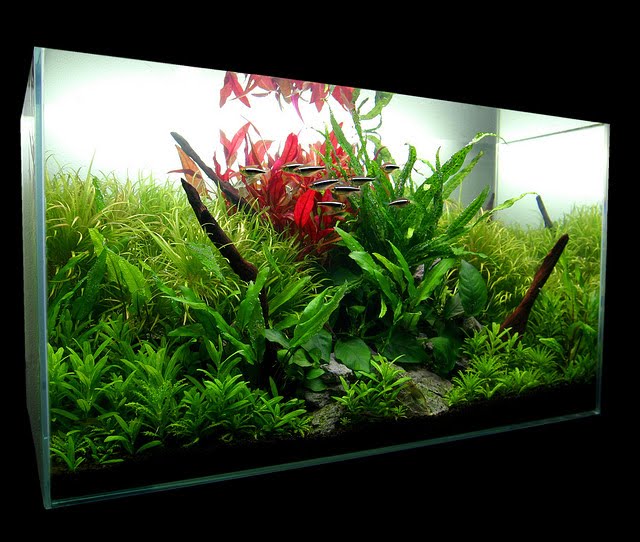
The natural style - As the term suggests, the natural style is just that - natural. Here, we strive to mime nature as closely as possible. Introducing a variety of plants without any particular order is the most important thing in this style. Think natural - in nature, you would not find groups of similar plants sitting pretty in some order. The aim is to cultivate a 'wild' look. It may seem that no planning goes into this kind of style, but this is far from the truth. Plants may seem to be placed at random without any serious coordination, but to achieve that striking display of 'wilderness' in your aquarium, you need to sift through the various plant varieties, and pick and choose the right ones.

The Dutch Style - This aquarium planting style is for the more serious planters. The aquarium is more for the plants, and the fish seem to be added in as an afterthought. You will hardly find these kinds of aquariums with superbly colored fish. There will just be a few colorless fish hanging about. The Dutch planted aquariums tries to replicate a verdant garden, in all its green glory. An important element in this style is terracing or layering. You will find that the aquarium is divided into terraces, with different kinds of plants growing on different layers. The back of the aquarium will be higher than the front. The plants are the main focus of this display.

There are two ways in which you can adapt the natural planting style to your aquarium. Firstly, there is the open style aquarium. In this kind of aquarium, the top of the aquarium is left open most of the time. The plants are allowed to grow right out of the aquarium. The tops of the plants are never trimmed. You need to be extra careful when you keep an open aquarium. If you have any jumpers in this aquarium, you will find that you are poorer by a number of fish after some time. An open aquarium is therefore not suitable when you keep such fish species.

A habitat aquarium can also adopt the natural style. The habitat aquarium is one in which you place ideally suited species of fish and plants that have the same requirements. A habitat display will take plants and fish from some particular geographical location, and mimic their ecosystem.

You can categorize the natural plants that should go into your aquarium depending upon their behavior. Very broadly, there are three kinds of underwater plants:

• Plants that float at the top of your aquarium
• Plants that will stay firmly rooted to the bottom
• Plants that come in a bunch and keep moving or floating around

Keep in mind that you cannot put in just any plant. Common household plants should naturally be avoided. Any plant that is not a water plant is bad news in the long run. They may adapt to the water initially, but may not be able to cope with their surroundings after a period of time. Changing your set up after some time is not very easy because aquarium plants also take time to adapt and grow.
Read more »

Choosing Aquarium Size for Aquascaping

Tuesday, February 15, 2011
How big should your aquarium be? Aquariums come in many shapes and sizes. It is advisable to choose an aquarium that is at least 10 gallons / 40 L, since small aquariums are much more difficult to maintain. The waste build up in small aquariums is quick and quite large in comparison with a larger aquarium. A small aquarium will therefore require very frequent water changes. Changes in temperature or water chemistry will also take place more quickly in small aquariums. Rapid changes in the temperature or water chemistry are harmful for fish and aquatic plants.

Expert aquarist recommended a 30 gallon/120 L aquarium to novice aquarist, since this will provide enough room for more fish and is easier to maintain as it has enough water volume to dilute fish waste. A larger aquarium will naturally be even easier to maintain, but the benefits of an aquarium that is larger than 30 gallon /120L is not as significant as the difference between a 30 gallon / 120 L aquarium and a smaller one. A 30 gallon/120L aquarium is large enough to buffer against to rapid changes in water values, and It is therefore an ideal beginner size.

Planted aquariums come in many shapes ranging from rectangular to hexagonal or even cylindrical. While making your purchase, it is not only the beauty of the piece that counts. Mundane matters like how easy it will be to clean out the aquarium regularly, and how to keep all the nooks and crannies hygienic are important considerations.

The height of the aquarium is also a very important aspect. An aquarium that is very deep is complicated to keep for the beginner aquarist. Increased height means greater difficulty when cleaning and your aquarium might therefore always carry some amounts of waste even after a thorough clean up. Poor light penetration is another problem with a deep aquarium. Plants will not thrive in water that has poor light penetration and special lighting is therefore needed in deep planted aquariums.

The art of arranging aquatic plants in aquarium or Aquascaping require nutritional support regularly to maintain the fertility of the water plants. This can be done if we know exactly the volume of aquarium water. Knowing volume of aquarium water is also important to calculate the filter pump capacity which needed, and it is also useful for us to provide nutrition or medication for a sick fish in the right dose.
Read more »

Choosing a Spot for Your Aquarium

Sunday, February 13, 2011
How to choosing a spot for your aquarium? First, you will need to think about how much free space you have for your aquarium, whether that free space is open to sunlight, and which shape that is best suited for that free space. Never place an aquarium in direct sunlight and keep the aquarium away from any heating or cooling surfaces because they will cause sudden and drastic changes in temperature within the aquarium, and sunlight will also promote the algae growth in the aquarium.

Keep your aquarium away from machines that give out a lot of sound or cause vibration, like the washing machine, since this will stress the fish. Water accessibility and easy disposal of dirty water and waste are some other important factors to consider while selecting a good spot for your aquarium as you don’t want to run around with buckets of water in your entire house. You will need where you can work easily and without any interference. In a family with children, special care has to be taken to keep the aquarium away from areas of frequent activity. You do not want your children to push or fall on the aquarium while they play and injure themselves or break the aquarium glass.

Any good home has a certain décor. So, while choosing a spot for your aquarium, you must consider whether the general décor and lighting in the room will make it an attractive place for the new aquarium. Take the type of biotope you plan to have in your aquarium into consideration when you decide if an aquarium will work with the décor of the chosen spot. Different types of biotopes works with different decors. A saltwater reef aquarium will for instance have a very different look than a well planted South American biotope.

You should also consider that an aquarium is very heavy so the chosen spot has to be able to support the weight of the aquarium. Any aquarium over 10 gallons/ 40L will weight at least a hundred and fifty pounds / 70 Kg when filled and decorated. The aquarium weight comes chiefly from the glass and the water, and decoration such as gravel will further add to this weight. Heavy aquariums will need to be kept on a sturdy stand rather than a shelf or a desk.
Read more »

Acrylic or Glass Aquarium

Saturday, February 12, 2011
How to choose between the acrylic and glass aquarium? As complement of the previous article Arylic vs Glass Aquarium, glass aquariums usually cost less and do not get scratches as easily as acrylic aquariums. Glass aquariums are also stronger, as they are bonded together by a silicone sealant. They need support only on the edges, unlike acrylic aquariums. Glass aquariums are very durable, and can last for many years without any problems. Proper aquarium lighting will make glass aquariums look almost as clear as acrylic ones. On a negative note can be said that glass aquariums are always much heavier than acrylic.

However, if you are looking for irregular shapes, than these are easier to obtain as acrylic aquariums. Acrylic aquariums are much clearer than glass, and have better insulation. This means that you can use a smaller heater in your aquarium to maintain the proper temperature. Acrylic aquariums do however scratch easily and can therefore only be cleaned with specially made soft pads. Removing scratches from acrylic aquariums can be quite a troublesome procedure.

The price can also be an important factor when it comes to buying your first aquarium. Glass aquariums are usually the cheaper alternative and there is also a wider selection of second hand glass aquariums than there is of second hand acrylic aquarium since glass aquariums are more durable.


When you have selected the best aquarium for your needs, it is time to take it home. Here is a checklist that you need to consider:
• Look for any scratches on the aquarium before you make the purchase.
• Test to see if there are any leaks in the aquarium.
• Take care not to load any heavy items inside the aquarium while you carry it home. This may lead to scratching or even breakage.

Get a tight fitting hood for the aquarium when you buy it. An open aquarium is never a healthy option. More water will evaporate form an aquarium where the water is open to sunlight, heat etc. Evaporation will lead to the water becoming concentrated with waste and animal- and plant debris, and can also cause water damages and mildew in the room around the aquarium.

Contamination from falling waste is another problem. With an open aquarium you will also risk casualties since fish often jump out of an open aquarium, and ending up on the floor is more often than not fatal for the fish unless you immediately spot it and put it back in the aquarium. Thus an aquarium needs a good and sturdy hood. These hoods come in various decorative shapes and colors. There are various aquarium accessories that go with your aquarium, other than the hood. An aquarium is a complete set of a number of equipment that works together.
Read more »

How to Set Up Aquarium Plants for Beginners

Have you been thinking of adding a freshwater aquarium plants to your home? It’s a lovely way to enjoy a miniature riverbed from the comforts of your own room. An aquarium, to put it simply, is a container that can sustain fish and other aquatic life for a longer period of time. Acquiring a good aquarium for your fish or plants is not a very difficult job as long as you give it some thought before you actually get it.

There are some obvious considerations to be taken in to account. Setting up a fully stocking a good aquarium will take any where between a couple of weeks and a month. The time that you spend with these basics step will save you a lot of time and trouble at a later stage.

There are several things to consider before you purchase an aquarium. How much time you are willing to spend on the aquarium? What kind of aquarium do you want to buy? What is the ideal spot for your aquarium? What kind of fish should you put in your aquarium? How do you keep your fish and their environment healthy in the easiest and quickest way? How much time would it all take to maintain? What should you feed your fish and how much? What should you do when diseases or algae strike? These are just some of the many questions that you need to think about.

A good and well stocked aquarium needs quite a bit of equiptment. Here is a simple list of the items that you will need for a basic freshwater aquarium plants :

  • An aquarium tank
  • An aquarium stand
  • A hood
  • Lighting equipment
  • Air pump
  • Heater
  • Thermometer
  • Aquarium Filters (internal or external)
  • Gravel
  • Aquarium Decorations
  • Maintenance items like scrubber, siphon tube, tweezers, scissor, algae magnet etc.

  • A beautiful freshwater aquarium with healthy, energetic fish swimming in clear waters and surrounded by green vegetation of the various aquatic plants is a stunning sight. But before you begin, you need to be armed with all the relevant facts.
    Read more »

    Choosing Aquarium Glue

    Wednesday, January 26, 2011
    Aquarium glue is a pretty touchy subject in the aquarium hobby. Different glues are used for different purposes. Some will dry clear and invisible, others will hold water as in an aquarium glued with silicone based glue. Silicone glue usually used to form a waterproof bond in construction and repair of glass aquariums.

    Simply put, people don’t trust the chemicals the glue can release into the water after extended periods of time. In my opinion, they are rightfully concerned as many of us spend countless hours and more money than we’d like to on our aquariums. That being said, here are some specific things to look for when trying to find a safe aquarium glue.

    Frag glue - What to look for:
    • Super glue products that say “100% Cyanoacrylate”
    • Look for Loctite Super Glue GEL
    Silicone glue - What to look for:
    • Make sure it is 100% silicone
    • Avoid anything with mold inhibitors
    • Clear or black silicone
    Aquarium Epoxy - What to look for:
    • Make sure its a reef safe brand
    Another thing to consider when choosing aquarium glue for aquarium construction is the glue pH. Aquarium with small or medium size (length 120cm) can use a glass glue with acidic pH. The characteristic of acid pH glass glue is dry and harden quickly, so that within 24 hours, the aquarium has to be filled water.

    As for the large aquarium, you can use glass glue with a neutral pH. The characteristic of this aquarium glue with neutral pH is a long dry (2-3 weeks) and is rubbery, so it is more robust and more resistant to earthquakes than the glue with acid pH.
    Read more »

    Glass Thickness and Strengths

    Sunday, January 23, 2011
    In aquarium design determined the glass thickness and strength is the most important before started the glass tank construction, arguably even more important than choosing the basic shape aquarium. Because glass thickness and strength will determine the durability of the glass aquarium in weight-bearing and water pressure. Glass aquarium which full of water if rupture it could be fatal to the humans who are nearby!

    When the glass aquarium was first filled with water you must conduct special strength checks whether the aquarium glass curved or not after filled with water three-quarters or more. If yes, stop filling the water then drain it again from the aquarium.

    The following are the comparison guidelines of the water pressure strength for float glass, tempered glass and laminated glass for aquarium design and construction (kg / m²).


    Read more »

    Choosing Basic Tank Shapes on Aquarium Designs

    Choosing Basic Tank Shapes on Aquarium DesignIn the previous article we have know that the Acrylic aquariums could be casted and molded into different shapes that were never though possible when only working with materials such as glass even to create new forms of fish tank that were previously unimaginable. However, before start to spilling all over your imagination in aquarium designs, a few things below should be considered first.

    First, never making a convex aquarium since a convex shape will make the contents look bigger than the original (distortion).

    Better to choose the aquarium size that elongate and low, rather than a narrow and high, because:
    • A small shapes and elevated potential to make fish become stressed by lack of oxygen (gas exchange is hampered because of the narrow water surface)
    • The aquarium that looks rises will make it difficult time decorating and maintenance, because the base of the aquarium difficult to reach by hand.
    • The high aquarium will make the necessary light penetration for plants photosynthetic, so we need a stronger light.


    The Aquarium shape which form on the left is a more advisable than that on the right. The consideration, the light penetration will be easier to reach the bottom of tank to water plant life. In addition, more easily decorated and maintained. Thus, there is no term aquarium that is too wide. The term that there is "aquarium that is too high".

    Choosing Basic Tank Shapes on Aquarium Designs
    The larger aquarium size will need more species of freshwater aquarium plants and tropical fish that can be maintained and more easily to maintain the quality of aquarium water. Conversely, the smaller of the aquarium size will be more difficult to maintain the water quality because a little change in one parameter of water can lead to large changes overall.

    Garden Aquarium is a combination of the aquarium and terrarium. Planning the proper aquarium design will determine the success of a combination of aquarium plants and pond plants or land which will create a unique atmosphere in the house.
    Read more »

    Acrylic Fish Tanks vs Glass Aquariums

    Saturday, January 22, 2011
    Acrylic aquariums are growing ever more popular in today's aquarium industry. Acrylic was introduced to the public in 1933. Advantages besides weight acrylic 45% lighter than glass aquarium are also more clearly visible than ordinary glass. Shaped acrylic aquarium can be designed according to our wishes, for example convex or hexagon, and without connections.

    Acrylic aquariums are slowly moving glass out of the spotlight for a variety of reasons. In this article I will be going through and detailing the strengths and weaknesses comparisons of glass vs acrylic fish tanks.

    Glass is much denser than acrylic, which means it also weighs a lot more. Glass aquariums weigh up to 10 times as much as their acrylic counterparts. When purchasing an aquarium, it would be best to go with acrylic.

    Acrylic aquariums are much lighter, and will cause much less stress on the stands and structures you will place them on. You can also purchase a larger acrylic aquarium that weighs less than a glass one, so you can bend the rules a little bit on weight restriction for your stand.

    Acrylic aquariums may weigh less than glass, but don't let that fool you. Acrylic is a very strong material, and it takes significant force to break an acrylic aquarium, and anyone who has every owned a glass aquarium can tell you about how even little bumps can cause cracks in the aquarium and cause it to be structurally unstable.

    Even though glass is thicker than acrylic, it is much weaker. Acrylic fish tanks are very resistant when it comes to bumps, however they are more easily scratched than glass aquariums.

    When it comes to customizing the shape of your aquarium, you are pretty limited when it comes to the glass aquarium. Glass is relatively brittle and rigid naturally, and because of this, its shapes and styles are very limited. Acrylic fish tanks on the other hand, can be molded to fit any shape and design that you could wish for.

    Acrylic aquariums could be casted and molded into different shapes that were never though possible when only working with materials such as glass. Acrylic fish tanks are also much easier to cut holes into when attaching an overflow system, with glass you need specialized tools and then you run the risk of cracking the whole panel.

    The only spot in my opinion, where glass outshines acrylic is in terms of cost, and scratch resistance. Glass is cheaper than acrylic, as it is more readily available. Glass is also very hard to scratch, and acrylic aquariums can be scratched with less force. Glass will also maintain its clarity throughout time, but acrylic when it gets a lot older can develop a yellowing tint to the acrylic.

    Well there you have it folks, a couple points to consider when you are weighing your options between glass and acrylic aquariums. If you are trying to get a custom aquarium for plants, I personally recommend acrylic, as it is a lot more durable to bumps and impact and acrylic can be molded to just about any shape.

    However, the acrylic also has a weakness that is easily scratched when we clean the moss with algae magnet, or when decorating the aquarium. For example, while rummaging through the sand at the bottom of the aquarium. This is why acrylic aquarium always covered with sheets of acrylic adhesive paper (protective) when shipped from the factory or shop. This is never happen on the glass aquarium.
    Read more »

    All About Glass Aquarium

    Thursday, January 20, 2011
    Long before Dr. Johnston introduced his first glass aquarium, initial glass production have started in Mesopotamia about seven thousand years ago. Many objects made of glass found with the luxury jewelry made of precious stones.

    Glass as building materials began to be used after the flat glass made in bulk in Rome, which is about 30 years BC until the year 345 AD with inflatable technique. Although the flat glass produced in small size and the quality was not good, but the inflatable technique is still used until 17th Century.

    In the early 20th century, this technique has a mechanism that can produce glass sheets larger, but a less flat surface, causing distortion of vision. The quality is still quite adequate for the glass window. However, to produce higher quality - for example for a glass mirror two glass surfaces should be polished flat and smooth, so the price is still expensive.

    Then in 1959, Pilkington managed to create a process of making glass called the 'float process'. This process can produce excellent quality glass; the surface is flat and free of distortion. The result of this glass is called a Float Glass.

    Float Glass

    The thickness of float glass ranging from 2 mm to 19 mm - with standard size 305 x 213 cm. While the largest size is 1143 x 305 cm. The varying dimensions give the flexibility to make Aquarium in a large size.


    Tempered Glass Aquarium

    Tempered glass is a hardened float glass by heating to 700° C, and then suddenly cooled by air spraying evenly on both glass surfaces.

    At the same thickness the tempered glass three times stronger than ordinary glass to handle water loads, wind, and collision. "Tempered glass" could not proceed further as cut, polished edges, or make holes. All dimensions and specification must be determined precisely before tempering process.

    When you use a tempered glass for aquarium, be careful with the edge or surface damage to the glass because it could be the source of the outbreak of the glass as a whole. When broken tempered glass fragments are dull edge pieces which prevent any serious injuries. Unlike annealed glass breaks into sharp edge pieces.


    Laminated Glass Aquarium

    Laminated glass is the unification of two pieces (or more) float glass which combined by a layer of Poly Vinylbutyral (PVB) film through the heating and pressing process.

    Poly Vinyl film used was very clear, distortion-free, not wrinkled, and did not reduce the glass transparent. PVB film also has a flexible nature and can be very strong blend with glass sheets. Thus, the safety level of laminated glass is very high.

    When the aquarium glass breaking then the laminated glass is not going to scatter but it's just cracked. Glass will remain attached to the film and mounted on a frame.

    Commonly two sheets of laminated glass used for large-sized aquarium. But for the Aquarium or Glass pond which very large or high usually used three or more sheets of laminated glass.

    As well as "tempered glass aquarium" before, the process of cutting and making holes can not be performed on laminated glass. Even if workable it would be very difficult and untidy. So, all sizes and holes must be known exactly before the laminated done.

    Read more »